

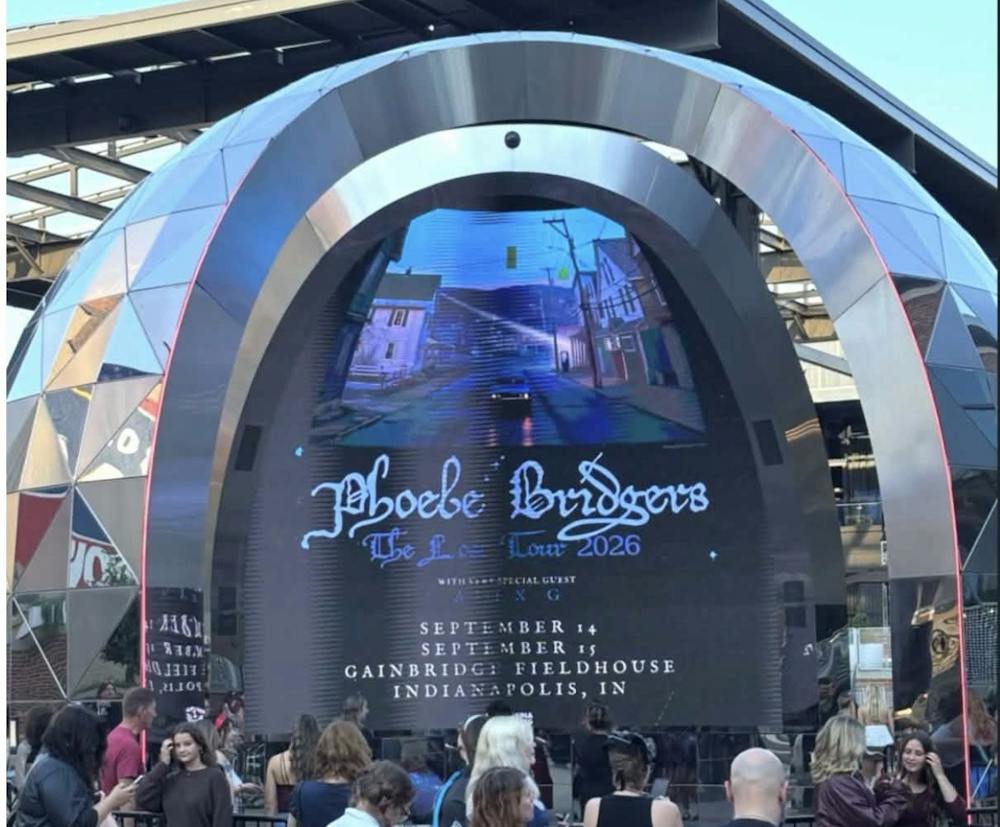
By pure chance both times, I was able to see Phoebe Bridgers perform at her Buskirk Chumley popup show this summer and once again on her official “Lost” tour. The latest show, night two in Indianapolis, is overall the fourth time I’ve seen her (once with boygenius, as a birthday present). Every time, I’ve been struck by feeling as though I’ve been transported into another world–one that doesn’t necessarily exist but is true; one that I can only access if I use my heart instead of my brain. If her popup show looked literally like being at a sleepover in your friend’s basement (are we allowed to say what happened at those now?), her stadium tour encapsulated what it is to look back on these memories. Bridgers sends the audience repeated invitations to connect with her on a personal level, and in that, to connect with the loss and fondness that come together to create a complicated nostalgia woven not only into her music, but into her performance and use of space. Her use of the physical space of a stadium cultivates intersubjectivity, which, in performance theory, is defined as connection between a performer and their audience that reaches beyond the performance. This is true in her use of two stages, how she curates visuals and effects for a show staged (almost) in the round, and her physical movement throughout the space, but also in her curation of aesthetics, stage presence, and purposefully almost-dialogic interactions with her audience.
The concert took place in Gainbridge Fieldhouse, in which the main stage was located at the narrow, far end of the stadium floor, surrounded by seating on three sides; the satellite stage was located across from the main stage, but was in the center of one section of the general admission standing room, and therefore was surrounded by the audience on all sides. The use of the main stage versus the side stage was intentional and marked the nature of the performance. The main stage was for bigger band songs, as it allowed more movement, energy, and crucially, more space for all members of her band. The side stage was for more intimate songs which included only Bridgers sitting on the floor playing a keyboard.
Bridgers’ visuals and light show used the space provided to further connect the audience to the performance. Behind the main stage, a screen projected visuals of Bridgers as she performed, which allowed all members of the audience to see her facial expressions. She often laughed or smiled while performing, and during heavy songs, her belting vocals were matched with equally emotive expressions. By clearly displaying emotions, she brought us into the emotional experience of the music.
Creative uses of space and lighting were common during this performance, and worked to transform the stadium space into a waking dream. During intermissions between Alex G’s opening set and the main set, I found myself transfixed by simply the color of the teal-blue lighting (having my phone locked in a Yondr pouch helped foster that meditative state, but the color really was divine in and of itself). Bridgers’ live visuals were often overlaid atop Viewmaster-esque solar system visuals, and her footage was often in black and white or VHS-fuzzy, already bringing us to view this as a distant, nostalgic memory.
Her use of sci-fi and fantasy imagery draws on cultural knowledge to bring us back to memories of a childhood filled with film, storytelling, folk knowledge, and fairytales. This imagery–both visual and lyrical–isn’t limited to this album alone. She’s played with these themes and concepts since at least Punisher (in songs like “Chinese Satellite,” “I Know the End,” “Moon Song,” “Halloween,” just to name a few), and has drawn on them in boygenius works, too (“Me and My Dog,” namely). Lost Weekend, however, makes them the center. She ties these aesthetics into memories of her father, whose death greatly inspired this album, as well as stories of the ways love blooms when it isn’t exactly meant to. By evoking this imagery, she gives her audience a cultural common ground–at least, her American Millennial/Gen-Z audience, who likely also remember their fathers showing them eighties sci-fi films, remember putting glow-in-the-dark stars on their ceilings, remember going to photobooths in dying malls. This, in and of itself, cultivates intersubjectivity.
The show began with “The Outside,” with Bridgers hidden away and a large, comet-shaped light fixture above the satellite stage emitting teal lights and flashing along with the vocals, as though we were hearing from a celestial body itself. The main stage was, initially, covered by a large translucent dome, which lifted at the beginning of the next song to reveal lights on the bottom ring, and then hovered to resemble a UFO as the full band exploded into “Motion Sickness.” Later, this dome would flip, so its concave side was facing the audience. It became a space for projected visuals (during “Moon Song,” for example, it became a full moon; it was also, namely, once Jupiter, and once a rapidly flashing slideshow of circular objects like eight-balls and eyeballs). The satellite stage rotated, albeit slowly, meaning that the audience could view many angles of performance, but which also played into Bridgers’ overall space imagery–like she was spinning on an axis all of her own. All of this combined meant that no matter where the audience found themselves in the space, they were able to see something, which not only afforded the opportunity to get their money’s worth but to become part of this collective dream state.
Bridgers’ stage presence is crucial to using the space provided to turn an audience of spectators into an audience of participants. Each time I’ve seen her, playful intimacy both with her band and with her audience is a major part. She often skips around the stage and gets into band members’ personal space to play alongside them. During this show, when she sang into a microphone stand, she often began the song with her hands clasped in front of her or behind her back. It felt like watching a child perform. Other lighting fixtures, such as blacklights on the sidestage, amplified that air of nostalgia and playfulness, especially when paired with Bridgers sitting criss-cross-applesauce on the floor and playing a keyboard.
Bridgers even poked fun at her audience: before playing one of her most beloved songs, “Waiting Room,” she called it simply, “A song I wrote when I was a child,” and giggled. (Yes, I was lucky enough to be at the night she played “Waiting Room.” I heard from friends on the opening night of the tour, she played “Georgia” instead and introduced it the same way.) We may take this song seriously, but Bridgers apparently sees it as somewhat immature and silly. She was grinning ear to ear during every line, and when she stepped away from the microphone, you could see her laugh. Yet she still played it with full effort and feeling, giving the audience the space, again, to connect.
Conscious interaction with the audience also brings them closer. At one point in the show, Bridgers walked off of the side stage and through the crowd, holding hands and giving hugs to her audience as she did so. Bridgers also invited the audience to become a part of her experience with the album through a semi-dialogic speech she gave right before she performed “Lost Weekend.” She first thanked anyone in the audience who had conservative parents but broke away from that ideology–called them strong in a way she didn’t have to be, because her father broke away from her grandparents’ ways of thinking. She asked if anyone was there with their dad, then asked if the dads wanted to “bellow” together. Then, she asked if anyone had a dead dad. After some scattered, almost nervous cheers, she sighed, “I recently became a part of that club.” Her vulnerability shines through her music–Lost Weekend is clearly and openly about grief in many places. Yet by peeling the curtain entirely back, she drew the audience directly to her. Again, it was like hearing from a friend at a sleepover.
Furthermore, Bridgers ended the show by telling the audience not once, but twice, that she loved them. The experience was nearly spiritual. Bridgers took us through her grief and her nostalgia with humility and kindness and rockstar badassery. After her May popup show, I remember rambling to my dad, who was there alongside me, that her music made me feel like a little kid again. I maintain this after this show, too–and I think that’s how she wants us to experience Lost Weekend.
The title of this article was suggested by Claire Kinderwater. Many of the concepts in this article were taught to me by Dr. Jane Goodman here at IU. Maggie Stewart took all the pictures–and drove me to this concert, so thank you!