


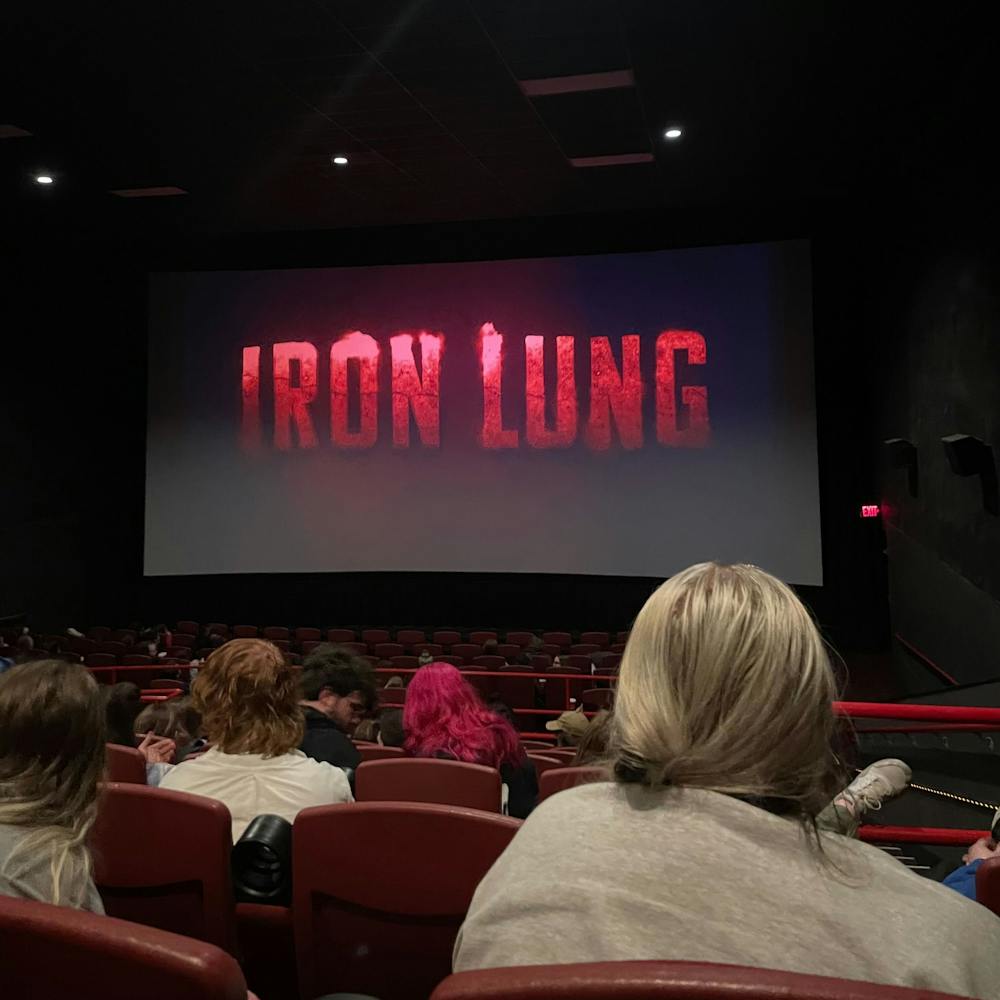
It is a very strange feeling to grow up watching Markiplier, this beloved, goofy, reaction-based let's-play YouTube icon, now making and starring in a major motion picture. The movie theater was packed full of nerds like me, unashamed to share their love for horror, for sci-fi, and most importantly, for Markiplier. When the movie was first announced to be in production, I was very excited. Not only because, as I stated, I am a fan of Mark and Iron Lung, both separately and together, but also because I thought it was an excellent game to choose for a film adaptation. The game is short, surreal, and uses simplified graphics. There are some lore and plot pieces, but plenty of room to develop more. The game has such an interesting premise that it allows the imagination to run wild and compound more onto it instead of being so densely packed with amazing ideas and concepts that there is no breathing room for creative interpretations. Because of my interests, as I host a podcast and radio show surrounding horror video games, it was such a fulfilling treat to live through this experience.
On its opening weekend, the film made roughly $9 million, blowing its original budget out of the water (no pun intended?), which is always inspirational seeing small studios and teams have a passion project be so successful. Even though this is his directorial debut and first major film role, Markiplier, or his real name, Mark Fischbach, is an actor. He was in the 2024 show On the Edge of Sleep, where he really got to prove his more dramatic acting side, and he has filmed, acted, and directed various lengthy YouTube projects that are “choose your own adventure” style, such as A Heist with Markiplier and In Space with Markiplier.
The original source material, the 2022 game of the same name, describes the name of the rusty submarine that you play the game in, but the claustrophobia and structure are very akin to the real-life medical device. To briefly sell it, both spoiler-free for the game and the movie, Iron Lung is a submarine-simulation low-poly horror game developed and published by David Szymanski where the player controls an unnamed convict who is sent unwillingly to explore an ocean entirely made of blood on a desolate moon in a small submarine. Gameplay is set entirely in the one-room submarine, with little to no room to move, but the features include using navigational equipment at the front, with its heading and position being displayed on the interface, and a camera at the back of the vehicle to photograph your surroundings outside of the sealed-in device. And to add onto this mess, the sub has no viewing ports or windows, with the player being trapped the whole time, forcing the player to use their map and the submarine's camera to navigate. The simplified graphics and gameplay mechanics make Iron Lung very accessible to play and interpret, but it’s the lore that intrigues me the most. In this futuristic world, humanity has colonized space, and an event known as "The Quiet Rapture" causes all stars and habitable planets in the universe to basically disappear, leaving only individuals aboard space stations alive.To secure the survival of humanity, a unified space government decides to investigate a desolate moon that has recently formed. The moon's topography is an expansive ocean of blood, believed to hold vital resources desperately required to sustain human life. A convict is sent to navigate the trenches, caverns, and caves of the blood ocean in a small submarine known officially as SM-13, nicknamed the "Iron Lung," to verify the existence of the resources. Due to the pressure and depth of the ocean, the main hatch is welded shut, and communications are lost shortly after submerging. The player is promised freedom upon their return to the surface and completion of the mission, but a note left by a previous occupant of the submarine warns them that it is a death sentence.
The reason why I am choosing to describe the details of the game as compared to the movie is because the film set and the plot of the movie are a 1:1 comparison, an almost perfect replica. When interpreting some specifics at a first glance, it does come off as awfully “video gamey” in real life, such as the giant light-up button for the camera, but it can be easily glanced over. Overall, it is incredibly impressive that the crew made a 2-hourlong movie out of a roughly 20-minute game, especially in how they stuck to the original concept and expanded upon it in a reasonable manner.
So much love and care was put into the movie in every single aspect, all the way from the ground up, from the writing, acting, cinematography, sound and music design, set, and so on and so on. This is a major breath of fresh air for the niche market of video game movie adaptations. The typical sequence that occurs with such movies is that a popular title will be picked up by a major company, such as Blumhouse, and produced into a movie. But this is only done because the franchise itself has a recognizable name with money attached to it, so it can lure in the dedicated fanbase. It works simply because the fans either know it's going to not be good but it's their favorite piece of media, or they are hopeful it is going to be satisfying, so they go to investigate. A recent example as of writing this is Return to Silent Hill, the most recent Silent Hill film interpretation of the iconic psychological horror game franchise. In short, the movie was hot garbage, and that’s not just my opinion but the general consensus of everyone, from the average moviegoer to die-hard fans. The reason why the movie was so awful was because the studio behind it solely believed from the title alone it would rake in money, so it does not matter how well put together the actual movie is in the end from a larger, corporate standpoint because they already know it is going to sell. And sadly, it works almost every single time. But Iron Lung altered this formula by simply changing one variable in the equation: actually doing their research on the source material.
The atmosphere of both pieces is so thick; the whole time I felt so hopeless and lonely due to the cramped, small, rusted, tight space. The surrealness of the game contributes to such as well. “You” are trapped in a sub, diving in a blood ocean, full of strange objects, and potentially being hunted by an unknown entity; it is all very peculiar and alluring. The ending sequence of the game and the different interpretation at the end of the movie are both in their own unique ways incredibly effective because the tension prebuilt the whole time is being compounded upon, so the viewer/player is waiting the whole time for a scare but never knowing when it's going to happen. Regarding the film's ending, seeing the body horror and grossness in the movie was a morbid treat. I mean, the setting is an ocean made of blood! The body horror shines through. It's nothing too extreme, but it's definitely impactful because you have become so attached to this character portrayed by Mark, following and watching his intimate struggle with no climax, and now he gets into physical pain, but his emotions persevere, and his anger outcompetes the fear of the situation, making the horror of his own body falling apart and becoming consumed by the blood all around him hit so much harder. As already stated, it is a very simplified game and does a good job setting up the lore, leaving gaps for the player to ponder more, which is why it was the perfect piece of media to translate and expand upon into a movie.
In a media landscape where “adaptation” often means dilution, Iron Lung feels like proof that passion and respect for source material still matter. It’s not just that Markiplier successfully made the leap from internet creator to filmmaker; it’s that he did it without abandoning the weird, niche, deeply specific horror that made people care for the game in the first place. Sitting in that packed theater, surrounded by people who grew up on similar experiences to myself around the weird and late-night horror deep dives that I did, it felt less like watching a “product” and more like watching a shared, community milestone. Iron Lung also is making red, iron-soaked waves in setting the precedent for what video game movies can be. You don’t need to sand down the weird, the taboo, or the unappealing in order to appeal to the broader audience. You don’t need to inflate a story beyond recognition just to pad out its runtime. Sometimes, the best thing you can do is trust the original concept, understand why it worked, and build outward. If a low-poly, 20-minute indie game about a prisoner trapped in a welded submarine in a literal ocean of blood can become a successful, emotionally effective feature film, then maybe there’s hope for all the strange little stories that deserve to be told, both in indie films and video games.
